
*** Hinweis: Die Veranstaltung fand auf Englisch statt. Daher ist der folgende Text ebenfalls auf Englisch verfasst ***
Planetary Health in a period of geopolitical upheaval
At the first hybrid edition of our Planetary Health Dialogue, co-hosted by the Wellcome Trust on April 20, we discussed – both in Berlin and online – the interactions between current geopolitical conflicts and ecological crises.
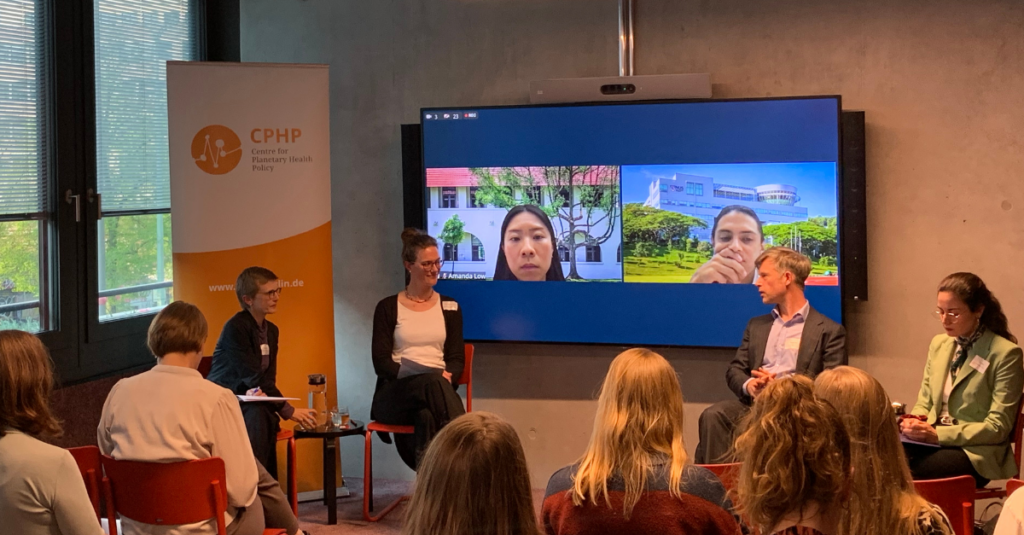
Together with Dr. Marion Schulte zu Berge (German Advisory Council on Global Change) Dr. Benjamin Pohl (adelphi, co-Author of the National Climate Risk Assessment) Sima Bulut (German Council on Foreign Relations) and Amanda Low & Max D. López Toledano (National University of Singapore) we examined how the climate crisis is fundamentally reshaping global security.
Climate change as a systemic security risk
At the Planetary Health Dialogue, experts explored how ecological decline, geopolitical tensions, and global health are becoming an inseparable security nexus. The discussion emphasised that climate change must be understood as a systemic risk that interacts with and intensifies current geopolitical conflicts in Ukraine, the Middle East, and beyond.
From local impacts to global instability
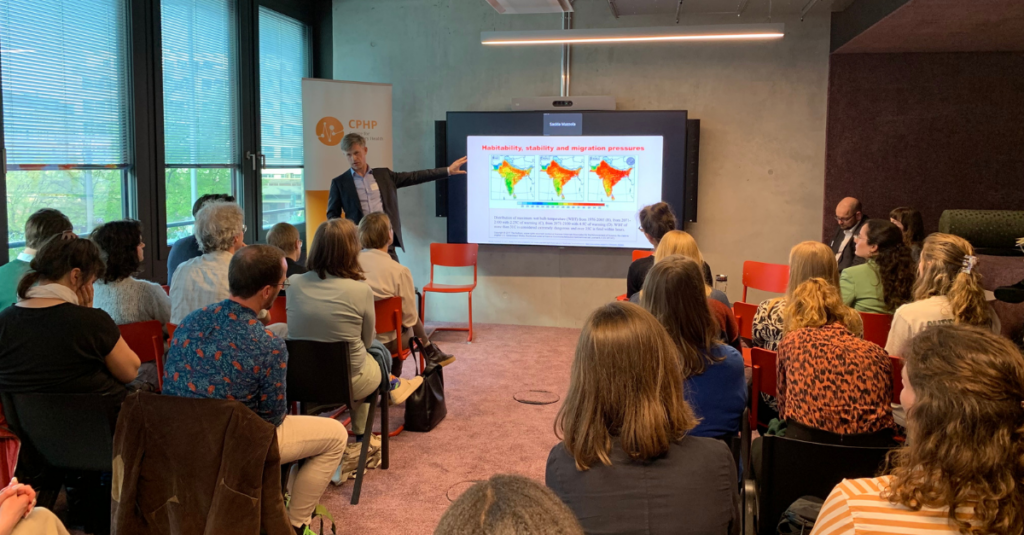
Dr. Benjamin Pohl (adelphi) presented findings from Germany’s National Interdisciplinary Climate Risk Assessment (NIKE, 2025), which identifies climate change as a top-tier external threat. These risks were categorised into three levels:
- Direct impacts: Visible local crises, such as flooding and rising heat-related mortality within the EU.
- External and domestic impacts: Climate-driven disruptions to global supply chains, financial markets, and investments that are often structurally underestimated.
- Systemic risks: Large-scale disruptions to global food systems and international stability, for example, water scarcity in critical wheat-growing regions.
The key takeaway is that security thinking must move beyond visible local damage to address indirect, transboundary impacts that undermine national stability.
Climate, mobility, and inequality
Sima Bulut (German Council on Foreign Relations) highlighted that climate change is a risk multiplier affecting human security, mobility, and foreign policy, with up to 2.6 billion people – especially in low-income regions – exposed to extreme heat and drought.
She stressed that climate-related migration is already a major form of adaptation, with around 250 million people displaced in the past decade, but responses remain fragmented and underfunded, including significant gaps in adaptation financing and global aid commitments.
Rethinking the dimensions of security
Dr. Marion Schulte zu Berge (German Advisory Council on Global Change, WBGU) presented the key fidings of the WBGU’s recent paper “Security: What we need to talk about” that calls for renewed efforts to align security policy with the goals of sustainable and socially just development.
She called for a multidimensional understanding of security that moves beyond traditional military definitions, outlining an integrated framework that brings together ecological stability, social cohesion, economic resilience and international cooperation.
The gap in planetary health security
Amanda Low and Max D. López Toledano (National University of Singapore) provided a critical perspective. Their scoping review on planetary health security of more than 10 000 sources found only one direct linkage between the fields of health security and planetary health.
They argued that current policy often favours containment over prevention. This securitisation frequently protects wealthier populations while shifting environmental harms onto marginalised communities that bear the greatest burden of ecological decline but lack the resources to mitigate it.
Moving towards policy action
The dialogue concluded with a clear mandate: Climate, health, and security are interconnected. To be effective, policy-making must shift towards:
- Nexus thinking: Breaking down silos between food systems, health, and defence.
- Preventive resilience: Moving away from reactive crisis management towards long-term ecological preservation.
- Equity-first responses: Ensuring that global security measures do not reinforce existing inequalities.
- Leading by example: Rapid, socially responsible decarbonisation in the EU is essential to maintain international credibility.
The dialogue was moderated by Dorothea Baltruks, Director of the CPHP and followed by a small reception, organised by the Wellcome Trust.
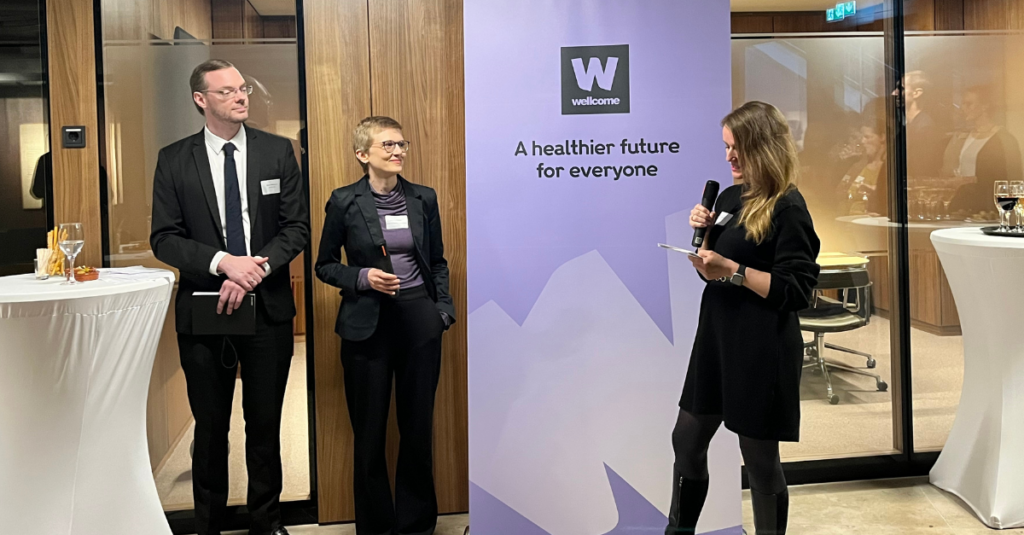
We would like to sincerely thank the experts and participants for the enriching discussion, and the Wellcome Trust for hosting us! The CPHP continues to lead these dialogues at the intersection of health, climate, and security.
Watch the recording here:

“Planetary Health Dialogue: Planetary Health in a period of geopolitical upheaval?” wart die 25. Veranstaltung der CPHP-Webinarreihe “Planetary Health Dialogues”, einem monatlichen Austausch mit deutschen und internationalen Wissenschaftler*innen, politischen Entscheidungsträger*innen und Akteur*innen der Zivilgesellschaft, um gemeinsam Ideen für einen Paradigmenwechsel hin zu Gerechtigkeit, Gesundheit und Wohlbefinden innerhalb der planetaren Grenzen zu entwickeln.